
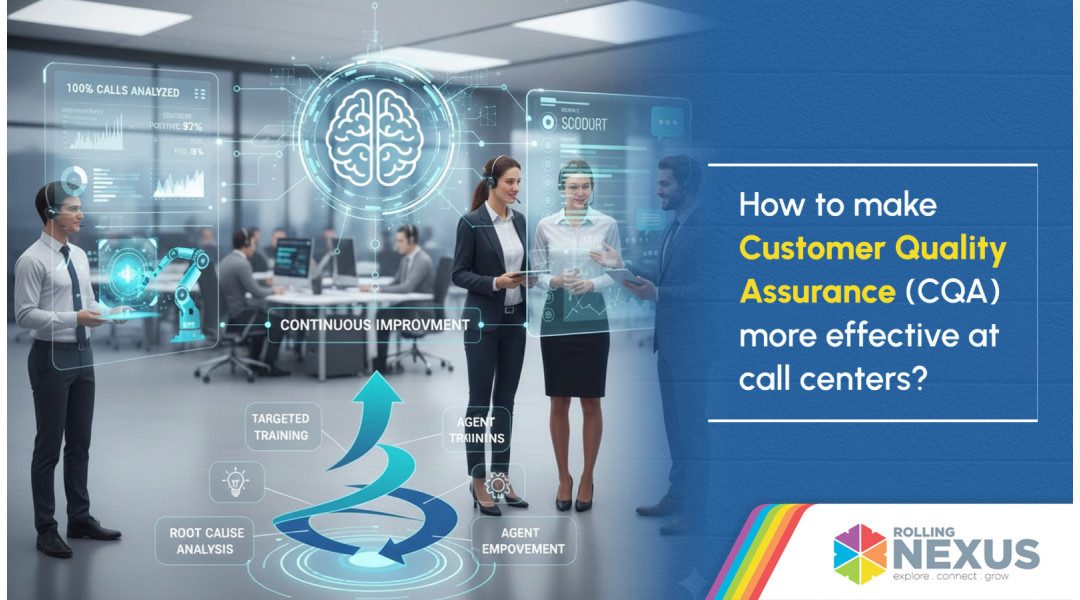
More customers means more businesses i.e. growth in sales, profitability and the branding of the organizational product or services. With the flow of customers in a positive manner, the organization can thrive longer. Call centers are the ones where the customers reach out first in case of a query about the product, complaint about the service or recommendation for more excellent customer service. The customers tend to expect positive customer experience (CX) from every organization, especially call centers where they can rely on for the solutions of their issues and queries. And customer quality assurance (CQA) helps to determine that the services call center agents are providing to meet the expectations of the customers or not. It involves the data collection, analysis, coaching, feedback for finding out if the customers are satisfied with the provided service or not.
Customer Quality Assurance (CQA) is an ongoing process of reviewing, analyzing and collecting data about how the call center agents communicate with the customers, measuring the performance whether it matches the predefined standards and lastly staying compliant with the legal requirements. CQA is one of the best measures to understand and measure the service quality that the call centers are providing at the call centers and the outcomes can be best used for analyzing the deviation, improving the performance and maintaining quality standards at the call centers so that same mistakes do not reoccur and the customer quality service can be delivered at the top notch.
Customer-client interactions from chats to the emails and the required KPIs used at call centers are monitored and tracked to ensure that the customers are getting the service quality guided by preliminary standards. The responsibilities of QA analysts come from evaluating such communication using the KPIs such as customer satisfaction, Average Handling Time (AHT) and others. The QA scorecards help to recognize the areas of improvement suggesting the processes for effective agents’ behaviour. The agents received constructive feedback regarding the interactions from the analysts and they can work on refining their skills of active listening, emotional control and others so that customer satisfaction gets enhanced and the business goals are met with the intelligent customer service agents.
The right CQA process can help to achieve the business goals on the basis of customer demands’ acquired from the data collected through the CQA process. The best practices to make CQA more effective at call centers are enumerated below:
As discussed earlier, the first and foremost process of CQA involves monitoring client-customer conversations whether be chats, emails or calls. The right software based on organizational requirements should be cherry-picked to automate the quality assurance processes. Both qualitative and quantitative data are to be included. The features like call recording, transcription, call monitoring and other required essentials should be available in the software. The effective KPIs should also be selected for coherent outcomes.
With the call monitoring in real time, the performance of call center agents can be upgraded as it allows constructive feedback mechanism instantly backed up with rectifications. Furthermore, immediate help and guidance can come in case of emergencies. For example, if the clients are on hold for too much time, their experience level may get degraded. In this condition, the real time call prescriptions will allow immediate help such as from supervisors or the concerned department. The issues are solved instantaneously if the calls are monitored in real time.
As the conversations are to be analyzed collecting the data, AI automation can help to get the required interactions in a minute. The use of automated AI workflows can be the best measures to identify the cavilling precipitates from the client-customer interactions. The AI assists in using the sentiment analysis and with this, the critical points can be addressed and effective training sessions can be held to the customer service agents for better communication in the next interactions.
In the CQA process, applying RCA is one of the most effective ways to collect the data from reliable sources and finding out the trends or patterns with the main causes enclosed in them. The post-call surveys, various performance metrics, QA scores can be the best sources to find out the root cause of the issues. For instance if the customers have to wait for longer times in the calls. The reasons may be due to understaffing, unavailability of the CSRs or call routing. With the RCA, the lead cause can be found out and the issues can be resolved in a jiffy.
Learning and development opportunities should be ongoing at the call centers. The role-playing activities, refresher training, coaching and synergy sessions, knowledge base training and other skill enhancement sessions become crucial for the CQA frameworks. With the sufficient training received, the call center agents can work on them and their skills to upgrade customer satisfaction, employee engagement and to resolve the major issues of call centers like burnout, absenteeism and reduced agent churn.
When call center agents get regular and constructive feedback, they can work on their performance to upgrade their skills that had deviations or gaps to fulfill the objectives. If the feedback is backed up with real examples, it allows the call center agents to be more practical in improving their lacking skills.
Rewards and recognition are one of the best methods to motivate the agents for their further efforts in the call center. Those agents who are involved at the CQA process should be rewarded and feedback sessions should be open. The mentoring sessions can also be a good choice for them to learn new strategies. Real time tools like live whispering, agent chat should be used as the key tools for rewarding the agents.
There are other several ways such as standardizing QA monitoring processes, call center QA benchmarking, establishing a customer centric culture, open and balanced feedback mechanism to make customer quality assurance more effective. Furthermore, the customers’ needs should be addressed. What does a customer want in fact? Is it the resolution? Is it clear communication? The feedback from customers is also a must in making the CQA more effective. If these practices are implemented, there is no doubt of call centers succeeding to render top notch quality service to the customers as Customers are the real kings of the business.