
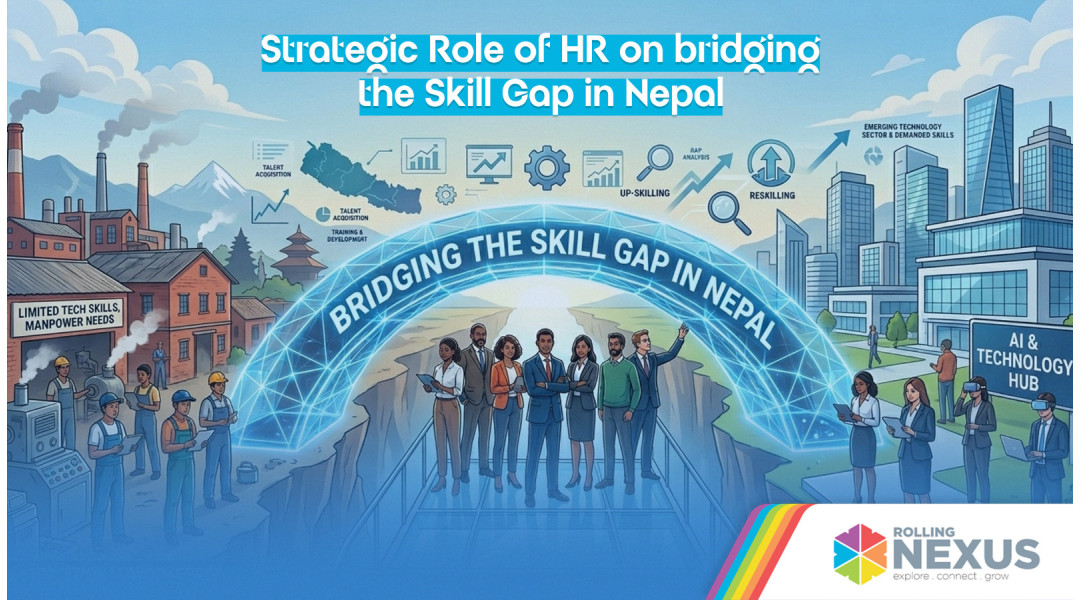
The Nepalese job market is at a turning point due to the expansion of businesses, the reshaping of industries through digital transformation, the emergence of startups, and the modernization of traditional sectors. Yet, the common concern of “We can’t find the right talent” echoes in every HR meeting from the banking sector to hospitality, from manufacturing to the developmental projects. This has not become just a recruitment problem but a thinkable structural skill gap issue. And in this changing landscape, Human Resources is no longer just an administrative function; HR has become a strategic bridge between education, workforce capability, and business growth.
Every year, thousands of students graduate from universities across the country. However, employers frequently report that graduates lack practical exposure, technical competence, soft skills, and industry readiness. On one side, organizations struggle to find employees who can perform from day one and meet their organizational expectations, whereas on the other side, young graduates or professionals struggle to find employment aligned with their qualifications. This mismatch has created the bizarre situation of frustration, unemployment, and underemployment.
Several factors have contributed to this skill gap, as enumerated below:
In this scenario, HR cannot remain reactive. The HR function must shift from “filling vacancies” to “building capability pipelines” to bridge the skill gap between organizations and fresh graduates or experienced professionals.
Traditionally, many organizations in Nepal have treated recruitment as a short-term activity, i.e., hiring when a vacancy arises. However, strategic HR begins with workforce planning. HR must sit at the leadership table and ask:
When HR aligns workforce planning with business strategy, the organization stops chasing talent and starts preparing for it. For example, banks providing digital banking services need data analysts, cybersecurity specialists, and digital product managers. If HR waits until the need becomes urgent, competition will already be high. It must be the strategy of HR to anticipate and prepare accordingly.
One of the most powerful roles HR can play in Nepal is strengthening collaboration between industry and academia. Many universities are open to feedback, but feel a lack of structured engagement from employers. HR consulting firms and corporate HR teams can:
When companies actively engage with educational institutions, they influence the quality of future talent rather than criticizing it. The partnership mindset transforms HR from a consumer of Talent into a co-creator of it.
Internships in Nepal are often informal and poorly structured. Many interns end up doing administrative tasks with limited learning outcomes, which makes them feel like a wasteful opportunity. Strategic HR treats internships as a talent pipeline. A well-designed internship program should include:
When interns are given meaningful work aligned with their qualifications, organizations can identify high-potential candidates early. Over time, this reduces recruitment cost and improves retention. The same applies to management trainee programs. Structured traineeships help groom future managers or leaders internally instead of constantly hiring externally.
Another key dimension of bridging the skill gap is upskilling existing employees. In today’s environment, skills have a short shelf life. For example, communication, problem-solving, teamwork, and adaptability are consistently identified as lacking among fresh graduates. These are not taught effectively in many academic settings. HR-led workshops and coaching programs can close this gap internally.
HR must foster a culture of continuous learning by:
Also, leadership development has been critical in Nepal. Many organizations in Nepal struggle because technical experts are promoted into managerial roles without leadership training. Strategic HR ensures that promotion is accompanied by development.
Employers frequently highlight challenges such as poor communication, low accountability, and limited critical thinking among entry-level employees. These gaps affect productivity and team dynamics. HR can address this through:
Workplace readiness is not only about technical ability. It is about attitude, professionalism, time management, and ownership. HR plays a crucial role in shaping these behaviours from the first day.
Modern HR is increasingly data-driven. Even in Nepal, progressive organizations are beginning to use HR analytics to identify skill gaps and predict future needs. HR can analyze performance data, training effectiveness, turnover patterns, skills inventory, and succession readiness. By maintaining a clear skills database, organizations can identify internal capability gaps before they become crises.
Offering workforce diagnostics and skill mapping services can create immense value for clients. Data-backed insights strengthen credibility and support strategic decision-making.
Nepal continues to face significant migration of skilled youth seeking opportunities abroad due to various factors prevalent in Nepal. While macroeconomic factors are beyond HR’s control, organizations can still improve retention. Employees are more likely to stay when they clearly see the following things within the organization:
Strategic HR designs clear career progression frameworks so employees understand how they can grow within the organization. When individuals see a future locally, the pull factor of migration weakens. Retention is not just about salary. It is about meaningful growth and development.
Digital transformation is reshaping Nepal’s job market. From fintech and e-commerce to digital marketing and remote service delivery, new skill requirements are emerging rapidly. Hence, HR must:
Organizations that ignore digital readiness risk falling behind. Hence, HR becomes the driver of this transformation by ensuring the workforce evolves alongside technology.
Nepal has underutilized talent pools, including women returning to work, persons with disabilities, youth from rural areas, people from the LGBTIQ+ community, and other diversified groups. Strategic HR can expand the talent pipeline by promoting inclusive hiring practices. Flexible work policies, remote work options, and targeted skill development programs can bring new segments into the formal workforce. Bridging the skill gap is not only about improving quality; it is also about expanding access.
Ultimately, bridging Nepal’s skill gap requires a mindset shift. HR cannot remain confined to payroll, compliance, and documentation. Those functions remain important, but they are not enough. Strategic HR asks bigger and more inclusive questions:
When HR leaders and professionals take ownership of these questions, they move from being operational supporters to strategic drivers of growth.
Nepal’s skill gap is real, but it is not insurmountable. It requires collaboration between academia, industry, policymakers, and HR professionals. Among these stakeholders, HR stands at the center, connecting talent supply with business demand. By focusing on workforce planning, structured internships, continuous learning, digital readiness, and inclusive practices, HR can transform the narrative from “talent shortage” to “talent development.”
For organizations in Nepal, the question is no longer whether HR should play a strategic role. The question is whether they can afford not to. When HR evolves, businesses grow. And when businesses grow with capable talent, the nation moves forward with them. So, the immense role of HR in bridging the skill gap in Nepal can’t be ignored.