
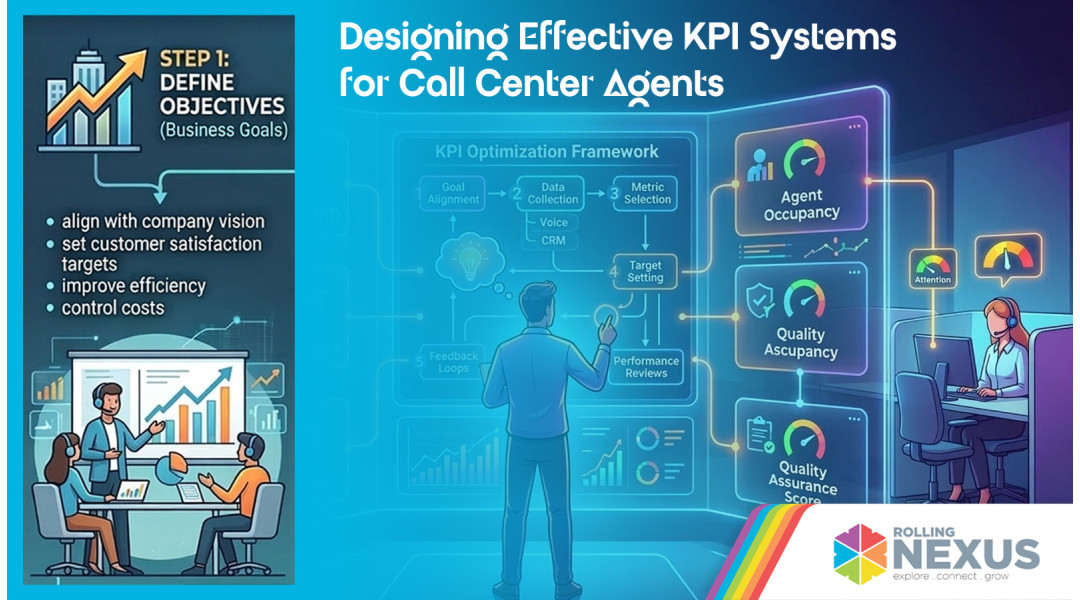
In today’s customer-driven business environment, call centers play a pivotal role in shaping customer perception and loyalty. Every interaction and conversation between a call center agent and a customer has the potential to strengthen or weaken the customer-business relationship. In such a high-impact environment, organizations have to rely on Key Performance Indicators (KPIs) to measure, manage, and improve agents’ performance.
However, designing an effective KPI system is not as straightforward as selecting a few common metrics. When poorly structured, KPIs can encourage undesirable behavior, reduce customer service quality, and negatively impact employee morale. When thoughtfully designed, they become powerful tools that align agent performance with organizational goals while enhancing the overall customer experience (CX).
This blog article explores how to design a well-balanced and practical KPI system for call center agents, with a clear understanding of what KPIs are, why they matter, and how they should be implemented.
Key Performance Indicators (KPIs) are quantifiable metrics used to evaluate how effectively an individual or team is achieving specific objectives. In a call center setting, KPIs are used to measure different aspects of an agent’s performance, including his/her efficiency, service quality, customer satisfaction, and operational discipline.
Unlike general metrics, KPIs are “key” because they are directly linked to business outcomes. For instance, reducing call handling time may improve efficiency, but if it leads to unresolved issues, it can harm customer satisfaction. Therefore, KPIs must be carefully selected to reflect both short-term performance and long-term value.
An effective KPI system answers three fundamental questions:
Balancing these dimensions is quintessential for rendering quality customer service and positive customer satisfaction, enhancing organizational trust and brand loyalty.
One of the most common challenges in call center management is over-reliance on a single category of KPIs, i.e., typically efficiency metrics. While operational efficiency is important, it should not come at the cost of service quality or customer experience. A balanced KPI framework generally includes three key dimensions:
1. Efficiency Metrics – Measure how quickly and productively agents handle interactions
2. Effectiveness Metrics – Assess whether customer issues are resolved successfully.
3. Experience Metrics – Capture the customer’s perception of the service
By integrating these factors, organizations can ensure that agents are not only working quickly but also delivering meaningful and satisfactory outcomes aligned with organizational objectives.
In our previous blog articles, we have discussed the KPIs in call center management, too. Below are the most widely used and effective KPIs, along with their practical implications.
FCR is the percentage of customer issues resolved during the first interaction, without the need for follow-up. FCR is a critical indicator of both efficiency and effectiveness. High FCR reduces repeat calls, lowers operational costs, and enhances customer satisfaction.
Example:
In a telecom call center, if customers frequently call back regarding the same billing issue, it indicates a low FCR. By equipping agents with better system access and training, they can resolve issues completely in one interaction/conversation, improving both productivity and customer trust.
It is a metric that measures customer satisfaction, typically collected through post-call surveys. CSAT reflects the customer’s perception of the service, making it an essential measure of service quality.
Example:
Two agents may achieve similar operational metrics, but the one who communicates clearly, listens actively, and demonstrates empathy is more likely to achieve higher CSAT scores. This highlights the importance of soft skills in service delivery.
AHT is the average time taken to handle a customer interaction, including talk time and after-call work. AHT is a key efficiency metric that helps manage workload and staffing requirements. While lower AHT is generally desirable, excessive focus on this metric can lead to rushed interactions and incomplete resolutions.
Example:
An agent who ends calls quickly without fully addressing the issue may reduce AHT in the short term but increase repeat calls, ultimately reducing overall efficiency.
It’s the evaluation of how well agents adhere to defined service standards, protocols, and communication guidelines. QA score ensures consistency, compliance, and professionalism in customer interactions.
Example:
An agent may resolve a query effectively but fail to follow mandatory verification procedures. This would negatively impact their QA score, as compliance is as important as resolution.
The extent to which agents follow their assigned work schedules, including login times, breaks, and availability, is termed the Adherence to Schedule. Adherence is essential for workforce management and maintaining service levels, especially during peak hours.
Example:
If multiple agents deviate from their schedules simultaneously, it can result in increased wait times and reduced service efficiency.
While KPIs are essential, their effectiveness depends on how they are implemented. Per organizational and agents’ needs and requirement, KPIs are to be designed. Several common pitfalls should be avoided:
Tracking too many metrics can create confusion and reduce focus. A concise set of 4–6 well-defined KPIs is generally more effective.
Focusing excessively on metrics such as AHT can lead to compromised service quality. Balance is critical.
Different roles require different performance expectations. For example, technical support agents may require longer handling times compared to general inquiry agents.
KPIs should not be used only as a performance monitoring tool. They should also support coaching, development, and continuous improvement.
An effective KPI system goes beyond measurement; it supports development and innovation. Managers should use KPIs to:
For instance, if an agent demonstrates high customer satisfaction but slightly higher handling time, coaching can focus on improving efficiency without compromising service quality. This approach fosters a positive performance culture rather than a punitive one.
KPIs should always reflect broader organizational goals. For instance:
Alignment ensures that individual performance contributes directly to business success.
Call center environments are dynamic. Customer expectations evolve, technologies change, and business priorities shift. Therefore, KPI systems should be reviewed regularly to ensure:
Periodic feedback from agents can also provide valuable insights into the practicality of KPIs. Hence, a feedback mechanism should be developed without strict barriers to communication.
Designing an effective KPI system for call center agents requires more than selecting standard metrics. It demands a thoughtful balance between efficiency, effectiveness, and customer experience. Well-designed KPIs should be able to:
Ultimately, the goal is not to make agents work for the metrics, but to ensure that the metrics support meaningful and high-quality customer interactions. When this balance is achieved, both organizational performance and employee engagement are significantly enhanced.