With the passage of time, new technologies emerge in the market, and as they offer favorable benefits, they become trending and are adopted by people. In a few years, we will have become familiar with blockchain and its numerous benefits for both users and providers. Among the various sectors and realms of the global market, the topic of blockchain has also grasped the project management field. The project management involves the initial processes of planning to the successful completion of the project that constitute time, budget, and outcomes as the major factors. And blockchain can be the reinforcement for the success of the projects. The responsibilities of the project managers are crucial from kickoff to the final deliverables. And blockchain can make the project management more interrelated with it.
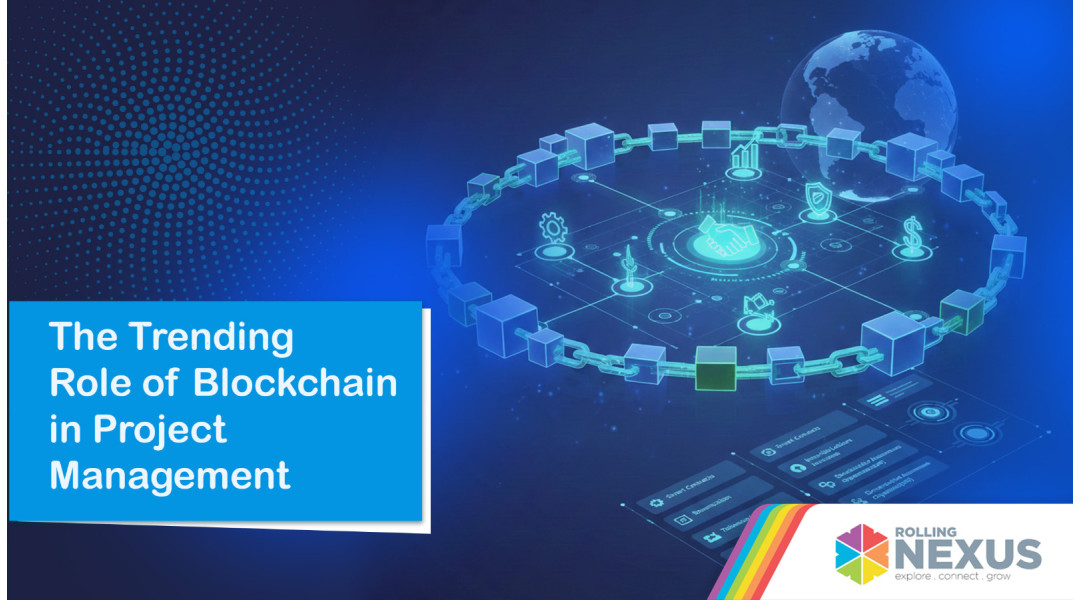
Expatiating on the Blockchain, it is referred to as the Distributed Ledger Technology (DLT) that plonks for digital computing that records transactions across multiple systems using node-to-node communication, where each blocks are connected to the previous blocks creating the chain, and due to the blocks interconnected like a chain, the distributed application is known as the Blockchain. So basically, blockchain is the sum total of different and multiple segments, or say, blocks that are recorded digitally on different systems or servers. Under the blockchain project management, the project team members can communicate with each other without unauthorized access, making it safer and secure.
From the beginning of the project execution, many challenges are faced in the project implementation, from Scope Creep to failed deliverables due to a multitude of reasons. The pre-project phase of agreement of contracts inaugurates the beginning of the project, and till the project delivery, many processes and changes are included in the project management. From the contracts to the essential documents, everything is stored in the digital sets in the common database with access by the project team members. These documents are safe from unauthorized scammers or persons. Every document and transaction is secured with a digital record that can be easily accessed within the team. In this way, blockchain can bring a remarkable revolution in project management with the features of a decentralized record-keeping system, automation of processes (smart contracts), and aligned communication/collaboration of the team members.
All the transactions and records are registered in a decentralized or distributed ledger based on real-time updates. Immutability, transparency, secured collaboration, easy access, and data security are some of the advantages that blockchain provides for the project managers and the team. Let’s delve more into the trending role of blockchain in project management.
As discussed earlier, the decentralized nature of blockchain makes project management easier. From task approvals to project progress reports, the records are to be maintained in different servers or systems. The maintenance of records in multiple systems can lead to project delays, hassles in decision-making between project team members, and other fraudulent cases. But with the blockchain, as every record is maintained transparently, the stakeholders have easy access to the real-time updates with smooth communication and networking.
The scope creep, budget delays, time constraints, and mismanagement lead to the project delays, and these are mainly caused by manual mistakes. With the smart contracts, there is automation of processes where the tasks are carried out, meeting the predefined or specific conditions only. For example, if one orders a burger from a fast food restaurant and pays the whole amount of Rs. 500 in advance, the blockchain sets up the smart contract as two conditions. The first condition can be stated as follows: if the burger is delivered within half an hour, the payment is accepted; otherwise, the advance payment will be refunded, which means no middlemen or broker is required, which prevents delays and other frauds in the system.
As blockchain involves a decentralized repository backed up by strong digital security, the confidential and sensitive records and information of the projects are secured. There is prevention of deletion, alteration of the records, fraud, scams, hacks, and other unauthorized issues. As the records are stored in a digital and decentralized database, they records are safe from such vulnerabilities.
The project team members work in different geographic locations, or some may work from Home, or some may get involved in hybrid working modules as well. As the records are stored in secure servers, providing access to all the stakeholders and team members is possible. With the easy and quick authorized access to the same records, there is zero chance of miscommunication and mismanagement of transactions amongst the team members, and thus, it helps to render a secure collaborative approach amongst the team members.
The blockchain ecosystem enables the visibility of information to all stakeholders on the same page. The project team members are well informed about every project phase as the blockchain insists on real-time updates. The transactions are recorded in a decentralized ledger, which embeds transparency, and the delays are eliminated, which fosters accountability and smooth efficiency in the project execution.
Apart from the multitude of benefits to the project management team, the introduction of blockchain in project management has to undergo several challenges, such as huge investment in technology, cost burden for specialized training for team members, government regulations, network issues due to huge data, and other factors, such as overdependence on traditional project management techniques and regulatory requirements.
The challenges are big, but there’s no doubt that the blockchain ecosystem can make a crucial revolution in the project management field, making it more effective, efficient, and productive. In the future days, there will be an immense role of blockchain in project management as technology is always evolving, and with the technological advancements, every sector has to embrace such changes for the benefit of all.