
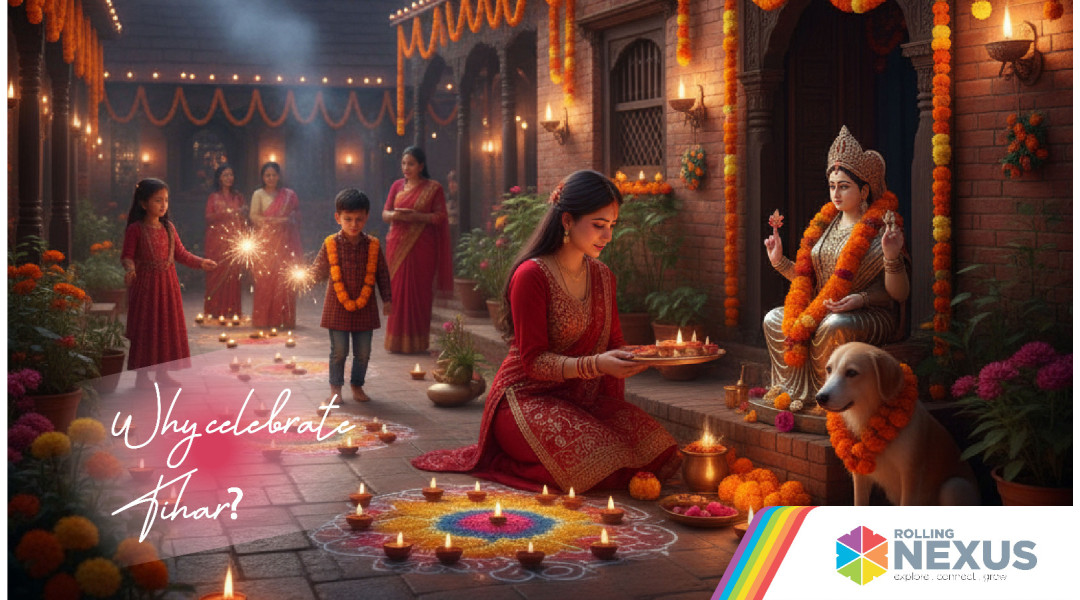
When the festivals belly up, the feeling of excitement, joy, and blissfulness springs up, as these are the days when all the families come together, feast together, and enjoy together. As one of our grandest festivals, Tihar is at our doorstep, and everyone is excited to welcome the festival. Previously, we published a blog about the significance of the Dashain festival and how this festivity brings immense joy to every Nepalese life. Today, we will be shedding some light on our significant festival, Tihar, which is also synonymous with Deepawali, Diwali, Swanti Nakha, and Yamapanchak.
Our festivals are filled with many legends and mysteries. One of the popular legends states that a lady named Yamuna was taking care of her rigorously sick brother, but suddenly, the God of Death, Yama, appeared to take her brother with him. Yamuna pleaded with Yama to let her do the worship ceremony of her brother and invited Yama to join in that ceremony. Impressed with her devotion, Yama offered Yamuna a wish, then Yamuna wished for the longevity of her brother, sparing him from looming death. She also enunciated that until the oil of Chika (Oil) Mandala gets dried and the Makhamali flower garland gets wilted, death can’t touch her brother. Then Yama granted her the blessing she wanted. And that’s how the Yamapanchak, i.e., Yama, means God of Death, and Panchak means five days have begun.
Many other mythologies represent the beginning of the Tihar festival and its significance, as Nepal is rich in the celebrations advocated by spectacular meanings and mythologies. As Tihar is celebrated for five days, each day represents a significant day. Let’s dive in.
On the very first day of Yamapanchak, we worship crows. Crows are often considered the messengers of Death and the informants of the God of Death, Yama. Sweets and edibles are offered to the crows. Tihar festival kicks off with this day of worshipping crows. Dhanteras, aka Dhan Trayodashi or Dhanwantari Jayanti, also falls on the same day. People buy jewelry, especially gold and silver, utensils, and home appliances on this day.
On the very second day of Tihar, dogs are worshipped for their loyalty and are rewarded with many dishes, garlands, and a Tika. Legend says that there are two loyal dogs, also known as Agents of Yama, that guard the Door of Hell, named Shyama and Sharvara. Also, Yudhisthira of the Mahabharata declined to go to Heaven without his loyal dog, and after that, that dog accompanied him to heaven. Also, dogs are the Bahaanas (vehicles) of Bhairab, the manifestation of Lord Shiva. There may be many mythological legends behind the celebration of Kukur Tihar, but their respect towards humans and their sincere loyalty are unreachable, and on this day to commemorate the loyalty, these furry beings are worshipped.
One of the main events of Yamapanchak is Laxmi Puja, when the Goddess of Wealth and Prosperity is worshipped. Oil lamps, i.e., Diyos, are lit, and special Mandalas and Rangolis are made at the entrance of the houses and offices to welcome Goddess Laxmi. On this day, cows are also worshipped as Hindus term the cow as Gau Mata. Their role in agriculture is immense, and they are amenable animals that give more than they take.
On the fourth day of Tihar, people worship Gobardhan mountain and oxen for their peculiar role in farming. Farmers express gratitude for their contribution to agriculture. On this very day, Newars celebrate Mha Puja, a unique tradition to worship oneself and one’s soul. Mandalas are drawn, and specific rituals are performed. The new year celebration of the change of Nepal Era is also performed on this day. Legend says that Sankhadhar Sakhwa cleared the debts of Nepal mandala and initiated Nepal Sambat. Cultural parades and many functions are organized on this day.
The fifth day is the last and special day for all the siblings as sisters place Tika on the forehead of their brothers, wishing for good health, prosperity, and longevity for their brothers. Gifts and blessings are exchanged. Brothers are offered special dishes and sweets. Brothers also give gifts to their sisters. The bonding between siblings is celebrated during this day. On this very day, Ranipokhari (Nhupukhu) is opened for the public, and the sisters who do not have brothers can go and take Tika from the priest there.
Tihar is more than a festival. Animals, humans, and the natural things, including Gods and Goddesses, are worshipped. Apart from its cultural significance, this festival holds a valuable place amongst the people for the following reasons, too.
Every house is decorated with Diyos and colorful lights. The whole country seems extraordinarily beautiful at night as lights are placed everywhere.
The garland of marigolds is placed on windows and doors, accompanied by the colorful lights. The houses, offices, and residences are cleaned and decorated with flowers.
Various Mandalas and Rangolis are made at the entrances and courtyards. Different artistic designs are to be seen during this festival.
It may sound weird, but this festival’s sound pollution is different. The use of firecrackers, Malta Bara, Jhijhire, is used, and definitely, it creates sound pollution, but during this festival, it’s accepted; however, everyone needs to be careful while using those firecrackers.
Ladies sing Bhailo songs on the day of Laxmi Puja, and after that day, men perform Deusi Ray. They roam the houses and collect donations.
Tihar is the most vibrant and bustling celebration where houses, streets, and every corridor are lit with lights to welcome Goddess Laxmi. The siblings’ bond is celebrated, animals are worshipped, the Nepal Era is changed, gifts are exchanged, one’s soul and oneself are worshipped, and families come together. The sense of togetherness is felt during this festival. Let’s celebrate this year’s Tihar with joy and happiness.
HAPPY TIHAR!